As of this morning of December 18, here is the PNR route (see the art card for details).
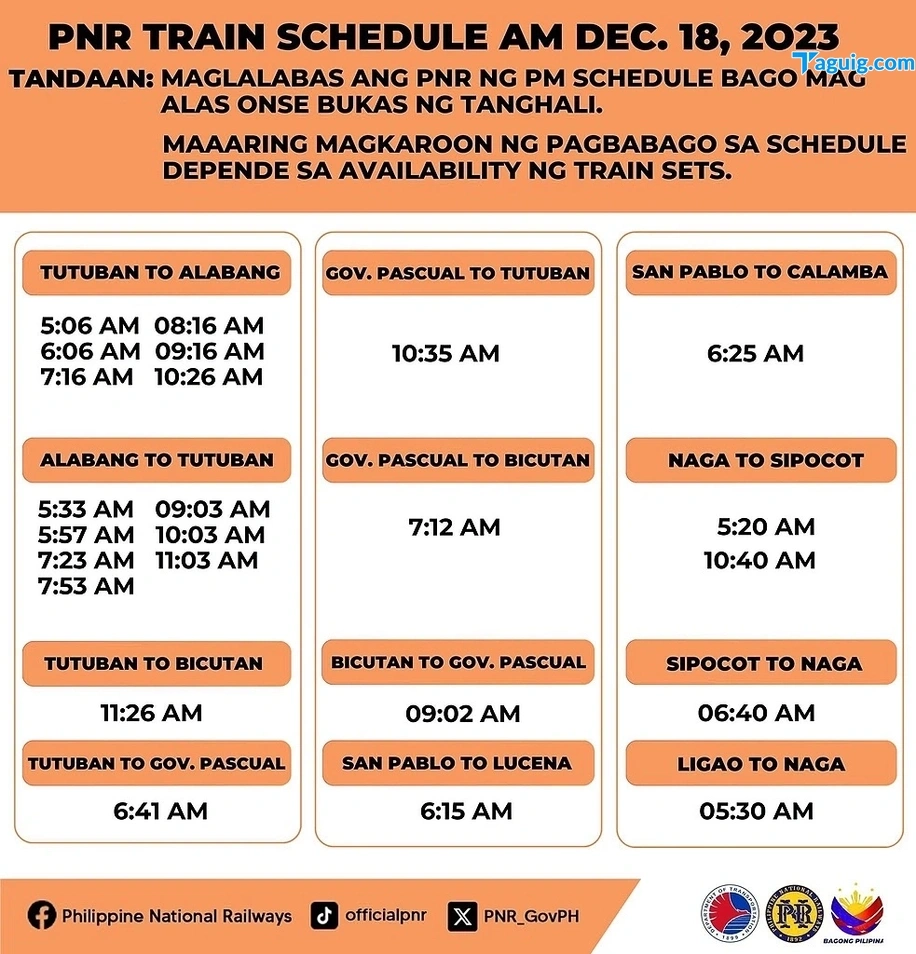
PNR releases new schedules on their Facebook page, Philippine National Railways, daily.
Under the leadership of PNR General Manager Jeremy Regino, the number of operational PNR trains increased from 7 to 13 in August 2022, and now stands at 15 in 2023.

The passenger count has also risen by 93.66% to 10.03 million this 2023 compared to 5.10 million the previous year.
PNR's revenue also saw a significant leap of 91.82% from P94 million last year to P181.70 million this year.
Travel on the Calamba, Laguna to San Pablo, Laguna route heading to Lucena, Quezon, and the Naga, Camarines Sur to Ligao, Albay route has been reinstated.

Currently, PNR is being modernized with the North-South Commuter Rail project and the proposed South-Long Haul project, according to Department of Transportation Secretary Jaime Bautista.
During the celebration of PNR's 131st anniversary last November 24, Bautista expressed his belief that the "golden years" of PNR, a popular mode of transportation in the 1960s and 1970s, can be restored.
"We are building a world-class railroad network - one that will not only be the pride of Asia, but of the entire world. New, modern, and fast trains that will run from Clark to Calamba and continue to Bicol. Our citizens will no longer waste time traveling every day. They will have more time for their families. We can finally address the traffic in Metro Manila," said Bautista.
"There is no doubt the NSCR and SLH Project will usher in the renaissance of the rail industry in the country. These rail systems will be the primary rail backbones, linking Metro Manila to the regions in northern and southern Luzon," Bautista added.
Thousands of jobs are expected to be created in the construction and operation of the National Railroad (PNR), which will significantly contribute to the country's economic development.
(Photos by Philippine National Railways)